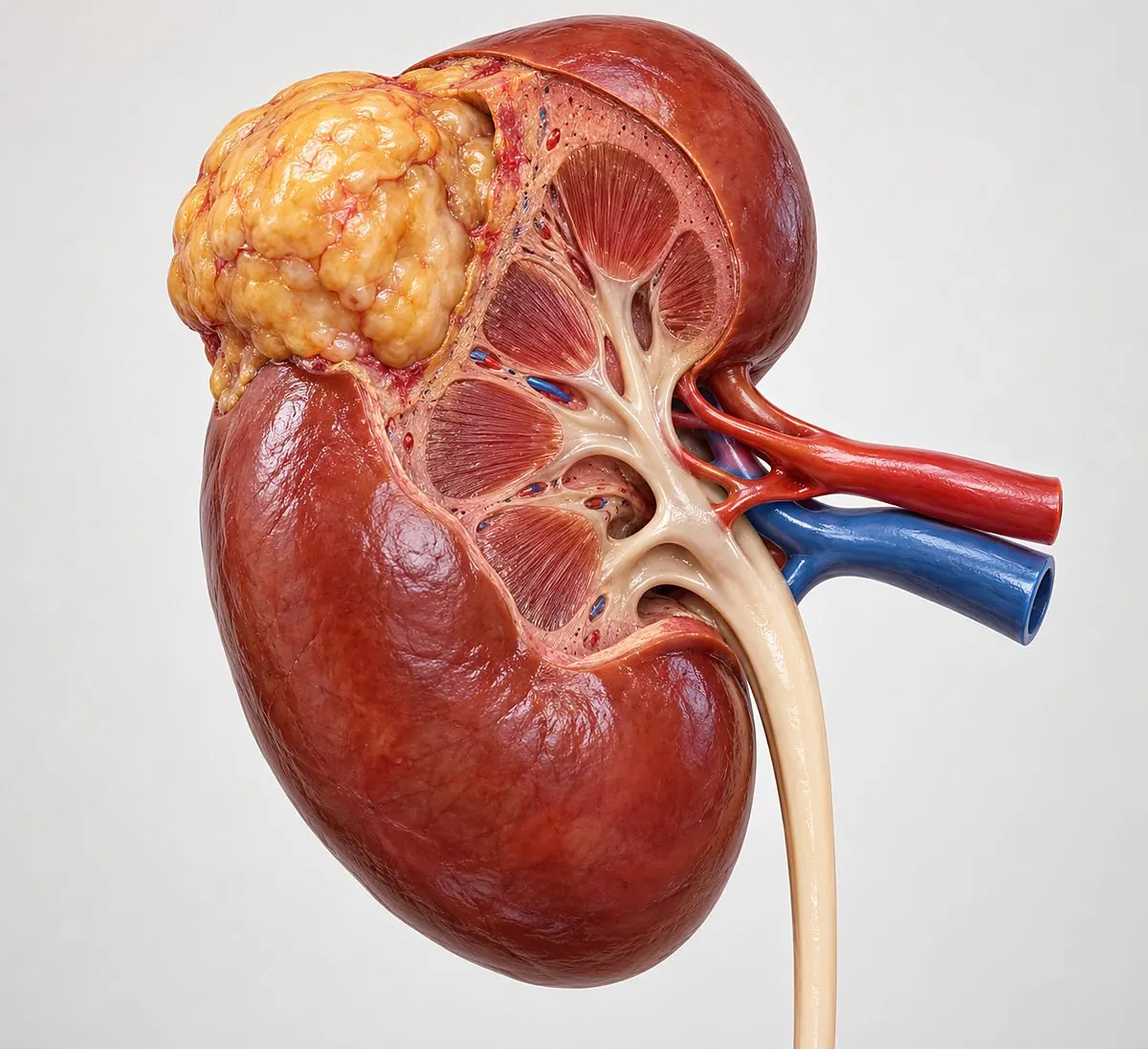
An ultrasound done for something else, such as stomach discomfort or a routine check-up, sometimes ends with a line in the report: "a cyst in the kidney" or "a mass in the kidney". It is natural to worry. But the finding is very common, and most kidney cysts are harmless. What matters is working out, with the right scan, whether the finding is a simple cyst or something that needs attention.
This article explains the difference between a cyst and a solid lump, which scan usually comes next, and how the options are decided.
Cyst or solid lump?
- A cyst is a fluid-filled sac. Simple cysts become more common with age, rarely cause symptoms and almost never need treatment.
- A solid lump (mass) is made of tissue, not fluid. Some solid lumps are benign, and some are Kidney Cancer.
- A complex cyst is a cyst with thickened walls, partitions or solid parts. It needs a closer look.
An ultrasound is a good first test, but it cannot always tell these apart. That is why a second scan is usually advised.
The next test
The usual next step is a CT scan of the kidneys with contrast dye, or an MRI if dye is not suitable. A blood test for kidney function (creatinine) is checked first. Sometimes a contrast ultrasound is used instead.
Cysts seen on these scans are graded with the Bosniak classification:
| Grade | What it means | Usual advice |
|---|---|---|
| I and II | Simple or minimally complex cysts, benign | No treatment and usually no follow-up |
| IIF | Slightly more complex | Repeat scans over some years |
| III | Thickened walls or partitions, a real chance of cancer | Surgery or close follow-up, advised case by case |
| IV | Solid parts that take up the dye | Likely cancer, treatment usually advised |
If the lump is solid
When a solid lump is found, the scan is read for its size, position and features, and whether it spreads outside the kidney. A kidney biopsy is not needed for every lump. It is sometimes done when the result would change the plan, for example in an older patient considering surveillance. Some solid lumps turn out to be benign, such as angiomyolipoma or oncocytoma, but scans cannot always separate them from cancer.
For a confirmed or likely Kidney Cancer, the options depend on size, position and the patient's health:
- Surveillance: for small lumps, especially in older patients or those with other illnesses, with regular scans.
- Partial nephrectomy: removing only the lump and keeping the rest of the kidney, often by Robotic Surgery. See partial vs radical nephrectomy.
- Radical nephrectomy: removing the whole kidney when the lump is large or the kidney cannot be saved.
- Ablation: freezing or heating the lump, in selected patients.
Symptoms that should not wait
Most kidney lumps cause no symptoms. See a urologist soon if you have:
- Blood in the urine, even once. See blood in urine.
- Persistent pain in the side or back
- A lump felt in the abdomen
- Unexplained weight loss, tiredness or fever
What to bring to your consultation
- The ultrasound report and, if available, the images
- Any CT or MRI and its report
- Recent blood tests, including kidney function
- A list of your medicines and past illnesses, including high blood pressure or diabetes
- Any earlier scans of the kidneys, to compare for growth
This article is consistent with the EAU Renal Cell Carcinoma guidelines and the AUA guideline on the management of localised renal masses.
Consultation
Dr. Anshuman Singh, Uro-Oncologist & Robotic Surgeon, sees patients in Lucknow at the Uro-Oncology OPD, Chandan Hospital (10 AM – 4 PM) and at Uro-Onco Connect, Gomti Nagar (6 – 9 PM), Monday to Friday, and by teleconsultation. Reports and scans can be shared in advance. Book a consultation.
Frequently asked questions
Is a kidney cyst dangerous?
Simple kidney cysts are very common and almost never dangerous. A scan with contrast can confirm that a cyst is simple.
Does a kidney cyst turn into cancer?
Simple cysts do not turn into cancer. Complex cysts are the ones that need follow-up or treatment.
Can an ultrasound alone tell whether a kidney lump is cancer?
No. An ultrasound can show that something is there, but a CT or MRI with contrast is usually needed to tell what it is.
Does every kidney lump need surgery?
No. Small lumps in some patients can be watched with regular scans, and many cysts need nothing at all.
Should I be worried if I have no symptoms?
Not necessarily. Many kidney lumps are found by chance and cause no symptoms. Having it checked is the right next step.
Treatment in Lucknow
Dr. Anshuman Singh is a Uro-Oncologist and Robotic Surgeon in Lucknow. Read about Kidney Cancer treatment in Lucknow and Robotic Surgery for Urological Cancers, or book a consultation in person or by teleconsultation.
This article is for general education and does not replace a personal medical consultation. How we write and review content.