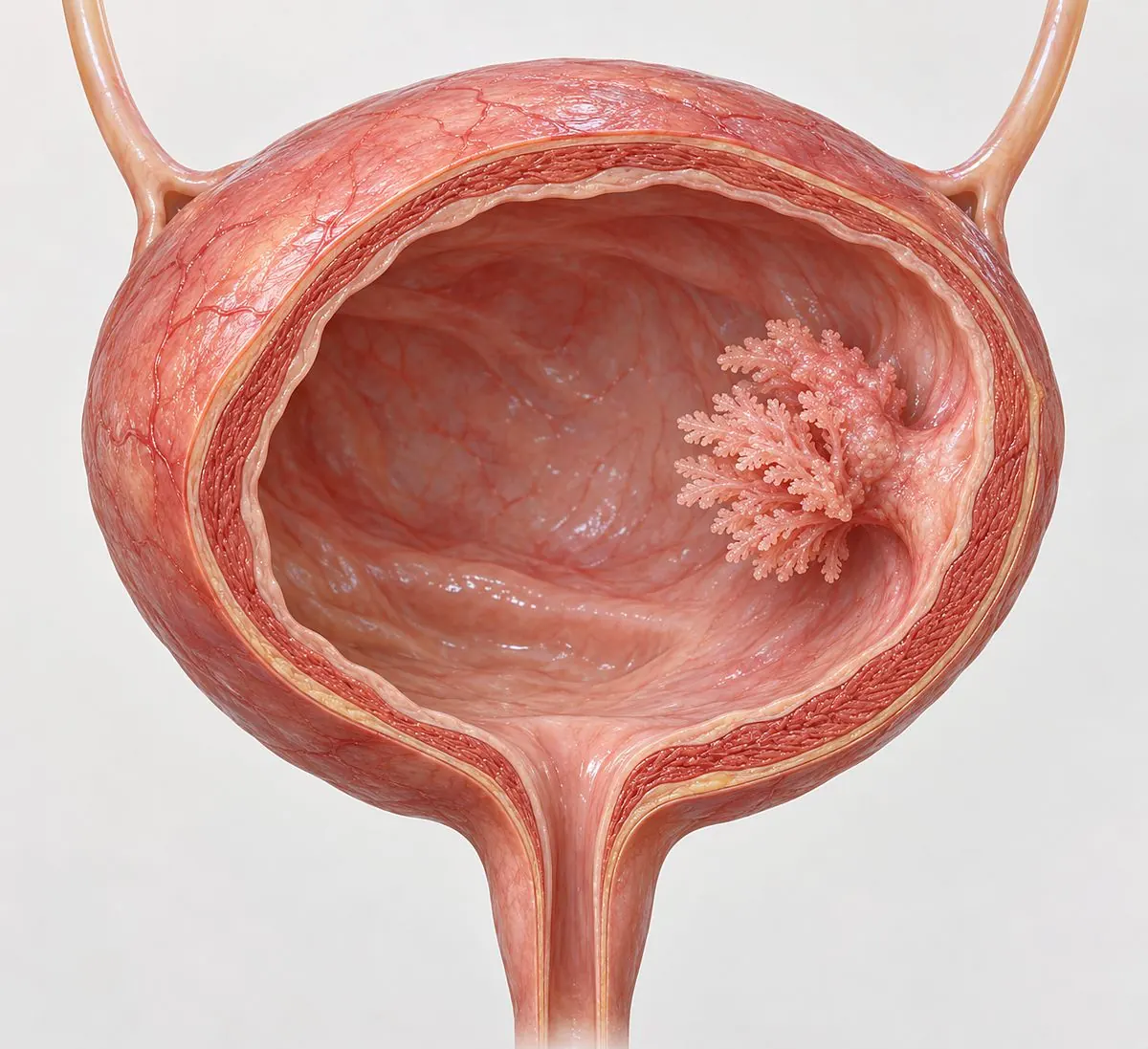
If a tumour has been seen in your bladder on cystoscopy, ultrasound or CT scan, the next step is usually a TURBT, or Transurethral Resection of Bladder Tumour.
Most patients have the same questions before the operation:
Is it painful? How long will I stay in hospital? Will there be blood in my urine? When can I go back to work? And what happens after the operation?
This article answers those questions in plain language. How to read the pathology report that follows is covered separately in TURBT for Bladder Cancer: What Does Your Pathology Report Mean?
What Is TURBT Surgery, and Why Is It Done?
TURBT is a telescope operation. There is no cut on the abdomen. A thin telescope is passed through the natural urinary passage into the bladder, and the tumour is removed through it using a small electrical loop or other energy source.
It has two purposes:
Treatment: to remove all the visible tumour from the bladder.
Diagnosis and staging: to send tissue to the pathologist, so that the type, grade and depth of the tumour are known.
This second purpose is why the way the operation is done matters. The surgeon aims to take the tumour together with a piece of the underlying bladder muscle (detrusor muscle), because only then can the pathologist tell whether the tumour has gone into the muscle.
Before the Operation
Preparation is usually simple:
- Tests: a urine culture, blood tests, and a heart and fitness check, along with the scan results.
- Blood-thinning medicines: tell the doctor if you take aspirin, clopidogrel, warfarin or a newer blood thinner. Do not stop them on your own. They may need to be changed or paused, depending on why you take them.
- Infection: a urine infection should be treated before surgery.
- Fasting: you will be told when to stop eating and drinking, as with any anaesthetic.
- Questions: it helps to write down your questions. This is also the time to ask about the plan if the tumour turns out to be more than a superficial one.
What Happens During TURBT?
- Anaesthesia: TURBT is done under spinal or general anaesthesia. You do not feel the operation.
- Duration: usually somewhere between 30 and 60 minutes, depending on the number and size of the tumours.
- How the tumour is removed: the tumour is shaved or cut out in pieces, or in some cases removed in one piece (en bloc resection). The base of the tumour is sampled separately so that muscle can be checked.
- Better visibility: special light techniques such as blue-light cystoscopy or narrow-band imaging can help the surgeon see flat or small tumours that are easy to miss under normal light. They may be used in selected patients.
- Catheter: a catheter is left in the bladder at the end, usually with fluid running through it to keep the urine clear.
- A single dose of chemotherapy: in some patients, a single dose of chemotherapy (for example mitomycin C) is placed in the bladder within about 24 hours of surgery, to lower the chance of tumour cells re-attaching. It is not given if there was a problem during the operation, such as a suspected hole in the bladder wall, or if there is heavy bleeding. Read more in Intravesical Chemotherapy for Bladder Cancer.
In Hospital After TURBT
Most patients stay in hospital for one to two days.
- The urine is usually pink or red at first. Fluid running through the catheter keeps it flowing.
- The catheter is usually removed after a day or two, once the urine is clear. If bleeding or tumour size was greater, it may stay a little longer.
- You will be walking the same day or the next. Pain is usually mild, and is more like a burning or an urge to pass urine than a wound.
You go home once the urine is clear enough, you are passing urine on your own, and you are eating and drinking normally.
Recovery at Home: What Is Normal?
Blood in the urine is expected. For the first one to three weeks, urine is commonly pink or light red, sometimes with a few small clots. This usually settles on its own.
- Drink plenty of fluids (unless your doctor has restricted them), so that the urine stays light in colour.
- A second episode of bleeding 1 to 3 weeks after surgery is also common. It is caused by the scab on the area of resection coming away. It usually settles with rest and fluids.
- Burning and frequency are common for a few days to a couple of weeks.
- Avoid constipation and straining. Straining can start bleeding again.
- Avoid heavy lifting and strenuous exercise for about two to four weeks, or as advised.
- Desk work can often restart after about one to two weeks. Return to heavier activity should be gradual.
- Do not drive until you are comfortable and no longer taking painkillers that cause drowsiness.
When to Call Your Doctor Urgently
Contact your surgeon or go to the nearest hospital straight away if you have:
- Bleeding so heavy that the urine looks like dark red juice, or clots that you cannot pass
- Inability to pass urine
- Fever above 38 °C, or shivering with fever
- Severe or increasing pain in the lower abdomen
- Persistent vomiting, or you cannot drink
Possible Risks of TURBT
TURBT is a commonly performed and generally safe operation, but like any surgery it has risks:
- Bleeding, which may occasionally need the catheter to be re-inserted and the bladder washed out, and very rarely a blood transfusion or another operation
- Urinary infection
- Bladder wall injury (perforation), which is uncommon. It is usually managed with a catheter for longer, and rarely needs surgery
- Narrowing of the urinary passage (urethral stricture), which can appear weeks to months later as a weaker stream
- Tumour not fully removed, or muscle not included in the sample, which may lead to a repeat TURBT
- The usual risks of anaesthesia
Your surgeon should explain which of these matter most in your case.
What Happens After the Operation? The Next Decisions
The tissue goes to the pathologist, and the report usually comes about a week after surgery. The report decides what happens next. In broad terms:
Low-risk tumours
Often need only the single dose of chemotherapy and regular check cystoscopies.
Higher-risk tumours (high grade, T1, or carcinoma in situ)
Commonly need a repeat TURBT, usually within about 2 to 6 weeks, followed by BCG treatment in the bladder. See BCG Treatment for Bladder Cancer.
When muscle is involved
TURBT alone is not enough. Further scans, and a discussion of options such as chemotherapy with bladder removal (radical cystectomy), or bladder-preserving combined treatment in selected patients, follow. See Is radical cystectomy always necessary?
Follow-up: Why Check Cystoscopy Matters
Many bladder tumours return, even when completely removed. Regular check cystoscopies allow a return to be found early, when it is easier to treat. The usual schedule, which your doctor adjusts to your risk, starts with a cystoscopy about three months after the first TURBT, then at intervals for years.
Attending these checks is one of the most useful things a patient can do after TURBT.
Related: Bladder Cancer · Blood in urine: what to do · EORTC risk calculator for non-muscle-invasive Bladder Cancer
Guidelines
Surgical technique and follow-up timing follow the EAU guidelines on non-muscle-invasive Bladder Cancer and the AUA/SUO guideline on non-muscle-invasive Bladder Cancer.
Consultation
Dr. Anshuman Singh, Uro-Oncologist & Robotic Surgeon, sees patients in Lucknow at the Uro-Oncology OPD, Chandan Hospital (10 AM – 4 PM) and at Uro-Onco Connect, Gomti Nagar (6 – 9 PM), Monday to Friday, and by teleconsultation. Scans, cystoscopy findings and TURBT reports can be reviewed in advance. Book a consultation.
Frequently asked questions
Is TURBT painful?
No, the operation is done under spinal or general anaesthesia. Afterwards there is usually mild discomfort, burning on passing urine and an urge to pass urine, which is controlled with simple painkillers.
How long does TURBT take, and how long is the hospital stay?
The operation usually takes 30 to 60 minutes depending on the tumour. Most patients stay one to two days, and the catheter is usually removed within a day or two.
Is blood in urine normal after TURBT?
Yes. Pink or light red urine for one to three weeks is common, and bleeding can return briefly when the scab comes away. Drink plenty of fluids. Heavy bleeding, clots that block the flow, or being unable to pass urine need urgent medical attention.
When can I go back to work after TURBT?
Desk work can often restart after about one to two weeks. Heavy lifting and strenuous exercise are usually avoided for two to four weeks. Your surgeon will tailor this to how much tumour was removed.
Will I need another TURBT?
Sometimes. A repeat TURBT is commonly advised for high-grade or T1 tumours, or when bladder muscle was not in the first sample, usually within 2 to 6 weeks. Low-risk tumours often do not need one.
Is TURBT the same as bladder removal?
No. TURBT removes the tumour from inside the bladder and keeps the bladder. Bladder removal (radical cystectomy) is a different, larger operation reserved for tumours that have gone into the muscle or are very high risk.
Does having a TURBT mean I have cancer?
Not always. Most bladder tumours are cancers, but the diagnosis is confirmed only when the pathologist examines the tissue. Some growths turn out to be non-cancerous.
Which doctor should I see for TURBT in Lucknow?
A urologist, ideally one who treats Urological Cancers regularly. Dr. Anshuman Singh, Uro-Oncologist in Lucknow, performs TURBT and plans the treatment that follows.
Treatment in Lucknow
Dr. Anshuman Singh is a Uro-Oncologist and Robotic Surgeon in Lucknow. Read about Bladder Cancer treatment in Lucknow and Robotic Surgery for Urological Cancers, or book a consultation in person or by teleconsultation.
This article is for general education and does not replace a personal medical consultation. How we write and review content.